How Student-Created Campus Maps Help UD Newcomers Find Their Way
Student-created campus maps help UD newcomers compare local knowledge, make informed map choices and see which details need clarification before sharing.
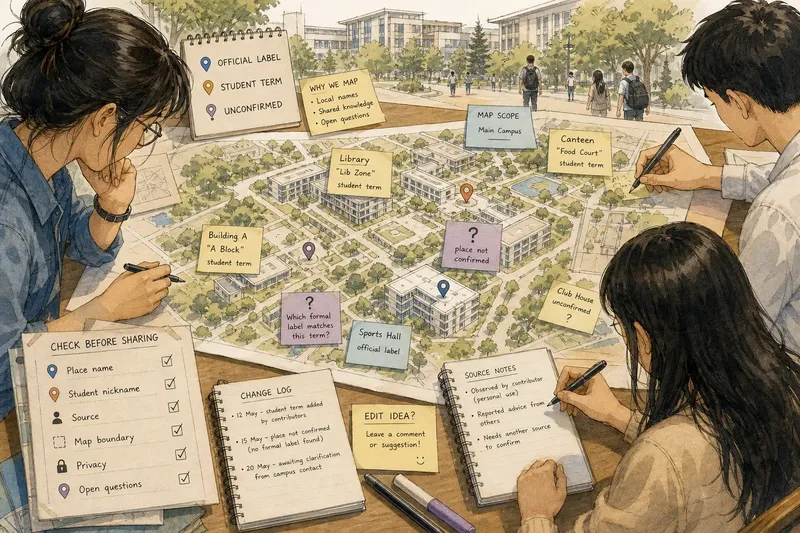
A student-created campus map can preserve the knowledge that rarely fits on a formal plan: how classmates refer to places, which details confuse newcomers, and what a map leaves out. At Đại học Đà Nẵng (UD), these maps can be more than route aids; they can record how students understand and describe their campus.
Student-created campus maps record local knowledge
A campus map made by students offers a particular point of view. Its value may lie in showing familiar names alongside official labels, or in collecting the questions newcomers ask about a place. That perspective is useful, but it is not the same as an authoritative campus directory.
Decide what kind of record you are making. A map might document student nicknames, mark places where people tend to gather, or show how different groups describe the same building. Naming that purpose helps readers interpret the information without assuming the map covers every campus or need.
Choose a map’s purpose before adding details.
Make differences in student language visible
Students may use an informal name for a building or area that does not appear on a formal plan. Rather than replacing one name with the other, record both when you know they refer to the same place. If that connection is uncertain, mark it as a question and invite clarification.
A paper map, a shared digital document or an annotated campus plan can all hold this information. A simple legend can distinguish official names, student terms and open questions. Keep the labels brief so that readers can see which kind of knowledge each one represents.
For example, write “official label” and “student term” as separate entries instead of merging them into one name.
Which details belong on a student-created map?
Should a map include student nicknames?
Include a nickname when contributors agree on what place it refers to, and pair it with a formal name if one is known. If its meaning varies between groups, mark that difference rather than presenting the nickname as universal.
How can contributors show what remains uncertain?
Use a visible question mark or an “unconfirmed” note beside the disputed label. If someone later clarifies it, record the source and the change instead of silently replacing the earlier entry.
What should be left off a shared map?
Leave out private messages, personal contact details and identifying information unless the person concerned has agreed to share them. If a detail could expose someone’s routine or private circumstances, describe the place without naming that person.
How can a map invite useful corrections?
Give readers a clear way to suggest edits, such as a comment area on a shared document. If contributors disagree, preserve both descriptions until the group can explain whether they refer to different places or different ways of naming one place.
Check each map entry before sharing it
These checks focus on the map as a record of student knowledge, not as a substitute for current campus information.
- Place name: If a formal label is visible on a campus plan, include it; if not, mark the label as unconfirmed and ask a relevant campus contact.
- Student nickname: If contributors identify the same place by that name, record the nickname alongside the formal label; if they disagree, show the different uses rather than choosing one.
- Source: If a contributor observed or uses the term personally, label it as that person’s account; if it was passed along, identify it as reported advice and seek another source before treating it as settled.
- Map boundary: If the map covers one campus area, state that scope; if readers could mistake it for a wider record, narrow its title or add the missing area only after contributors supply reliable details.
- Privacy: If an entry names a person or reveals a private routine, remove that detail unless the person has agreed to its inclusion; otherwise, describe the relevant place without identifying anyone.
- Open questions: If a label or location remains disputed, mark it visibly; if contributors resolve it, add the clarification and retain enough context for readers to understand the change.
For each entry, a reader should be able to tell what is known, who it reflects and what still needs a response.
Work through a map entry without overstating it
Say a student group is preparing a paper map and has a campus plan, two notes about a place, and one blank label on the draft. These are invented starting details, not claims about a particular UD location. The notes use the same informal name, but neither identifies the place by a formal label.
- The group writes the informal name on a removable note and marks it “student term”. The map now preserves the language contributors supplied without implying that it is an official name.
- One student checks the campus plan for a matching formal label. In this invented situation, the plan does not make the match clear, so the group leaves the formal-name field blank rather than guessing.
- The group adds “place not confirmed” beside the entry and writes a question for a relevant campus contact: “Which formal label corresponds to this student term?” The unresolved point is now specific and visible.
- They remove a contributor’s name from the notes and keep only the description of the term. The map retains the useful language while avoiding unnecessary personal information.
- They add a margin note that the entry is awaiting clarification. If a campus contact later confirms the label, the group can add it beside the student term; if the match remains unclear, the map can continue to show both the term and the open question.
The resulting entry records what the group actually has: a student term, its source category and an unanswered naming question. It does not turn an uncertain label into a campus fact.
Keep changes understandable to later contributors
A map becomes more useful when later readers can see why an entry changed. Keep a short note beside an edit, such as “formal label clarified by campus contact” or “student term reported by contributors”. If a name is removed, retain a neutral note that explains the kind of correction without preserving private details.
Student-created campus maps at UD can help newcomers and current students understand how campus knowledge is shared. Treat each map as a collective record with a defined scope, visible sources and room for correction. A reader should leave knowing which labels reflect student usage and which still need confirmation.